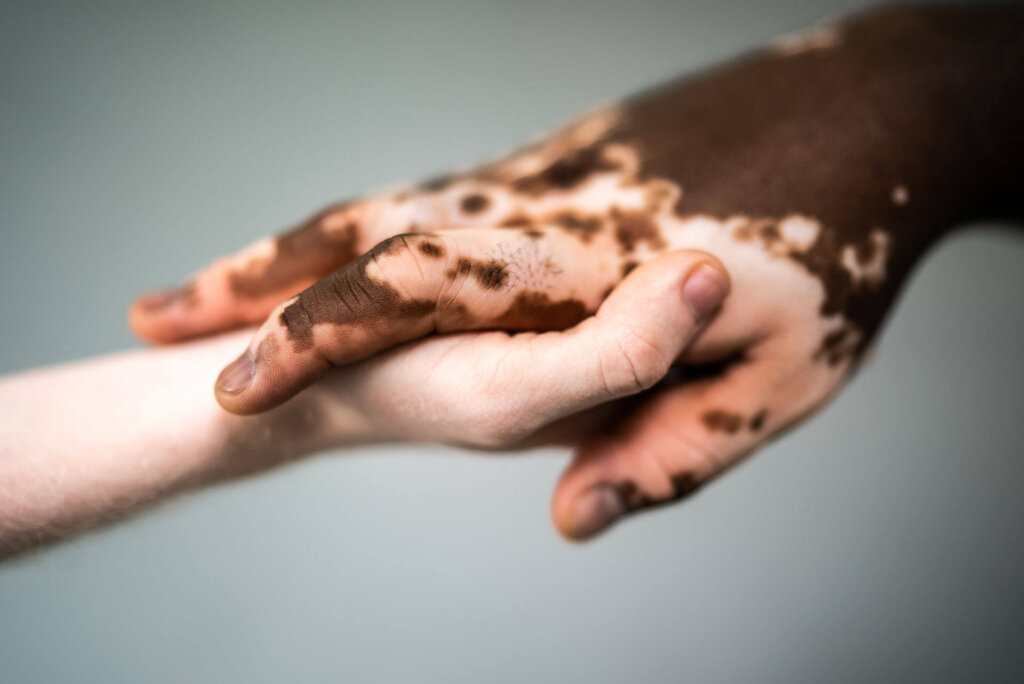
If you have vitiligo, you probably know that you should be careful in the sun. But why is that so important? And what does ‘sun safety’ really mean? With contributions from our in-house healthcare professionals and members of the vitiligo community, we’re going to unpack everything you need to know to be sun confident this summer.
Why does vitiligo affect my sensitivity to the sun?
While it is still not fully understood, vitiligo is believed to be an autoimmune condition where the immune system mistakenly attacks melanocytes – pigment producing cells – in the skin. This damage renders the melanocytes ineffective at producing melanin and results in depigmented patches of skin. Without the UV-protective properties of melanin, these patches are extra sensitive to the sun.
Prolonged exposure to sunlight causes damage to our skin, no matter your skin type. This is, at first, invisible to the naked eye but, if the exposure is long and severe enough, in people with lighter skin types, this damage will eventually manifest as sunburn. On the depigmented skin seen in vitiligo, this can happen very quickly, causing inflammation and pain. Researchers have even found that sunburn or other skin trauma could trigger new vitiligo patches to occur. This is known as the Koebner phenomenon (KP) and it is thought to be a result of the inflammatory response triggered by the sun.[1] Pain and itching are also not uncommon following sun exposure.
Gina, who has vitiligo, said, “I couldn’t go to the beach anymore because my skin had no protection and would literally bleed [from scratching].”
Others have said that their main reason to seek treatment would be because of the discomfort and pain felt when out in the sun during the summertime.
Sunburn is not the only risk when exposing your skin to the sun. The link between sun exposure and skin cancer has long been established, with UV rays causing the DNA damage in our skin that can lead to malignancies. And while some studies have suggested that people with vitiligo may have a lower incidence of skin cancers,[2] prolonged DNA damage can still lead to both melanoma and non-melanoma skin cancers, and so adequate precautions should be taken.
Additionally, UV radiation, in particular UVA waves, breaks down collagen and elastin in the skin, leading to the wrinkles and sagging we associate with premature skin ageing.[3] In people with vitiligo, this can mean an uneven ageing process whereby the depigmented skin ages faster than pigmented skin.
FAQs
Reading this, it seems the sun is my enemy, but can I at least enjoy the summer safely?
Of course you can, the sun isn’t your enemy when you know how to manage it, but be aware that…
While phototherapy may help, exposure to UV light should be controlled
If you are receiving narrowband UVB treatment, ensure that you avoid additional sun exposure on your treatment days. While it is true that UVB light waves can stimulate pigmentation (phototherapy or narrowband-UVB is the standard of care for vitiligo treatment), natural sun exposure is unpredictable. In a clinical setting, phototherapy is carefully controlled, and the effects are closely monitored. Without a doctor guiding you, the risk of sunburn from sun exposure often outweighs any benefits.
Covering up when going outside helps prevent unwanted exposure
Clothing with a built-in ultraviolet protection factor (UPF) is the best way to ensure you’re getting the highest protection. However, these brands can be expensive and not that stylish, so how else can we tell how protective our clothing is? Choose darker or brighter colours, as these shades absorb more UV rays than lighter colours. Also, fabrics with a tighter weave are more protective; a good test is to hold the fabric to the light – the more you can see through it, the less protection it offers. A wide-brimmed hat and UV-blocking sunglasses are essential.
But clothing could use some support
Choose a broad-spectrum solar protection that will protect your skin against both UVB and UVA radiation with an sun protection factor (SPF) of 50 or higher. Mineral formulas (those formulated with zinc or titanium oxide) tend to be gentler on sensitive skin. Most importantly, regular reapplication is the key, especially if swimming or sweating.
It sounds silly to remind you of this one but, chase the shade!
Sunlight is strongest between 11am and 3pm. When possible, plan outdoor activities for the early morning or late afternoon, or sit under an umbrella or tree canopy during the hottest hours of the day. A cloud’s shade is not true shade. In reality, up to 80% of UV rays can penetrate through cloud cover, meaning your skin is still exposed to harmful radiation even on overcast days.[4]
What’s more, certain environments can intensify UV exposure due to reflection: did you know that snow can reflect up to 80% of UV rays, sand on a beach about 15%, and even freshly cut grass or light-colored concrete can bounce sunlight back onto the skin?[5] These reflective surfaces can increase your UV dose without you realising it, making sun protection essential.
The summer doesn’t have to be a time to hide away, with the right precautions and an understanding of how the sun affects you; you can ensure your skin is protected every day.